Remember back in high school, when there were different "groups"? You may have called them cliques or crowds. Some were preps, some were jocks (many were both). To my memory, hipsters were not a thing then, but goths were. I think emo, too? And at a magnet school I always felt that nerds got a lot more respect than Hollywood ever depicted. There were studious Asians and lots of gangbanging Asians, too. That was K-12 life. In adult life, we still have crowds, and I see a ton of confusion on an almost daily basis that surrounds the usage of which group someone belongs to. But set aside the groups themselves, even the nomenclature gives us trouble.
Showing posts with label Chinese. Show all posts
Showing posts with label Chinese. Show all posts
Monday, March 17, 2025

Tuesday, December 27, 2016
Chinese Phood Epilogue: Do It Yourself Sichuan Lobster & Sichuan Steak
Introduction: I was asked by a friend for some recipes based on one of the dishes that I had mentioned as a part of the Chinese Phood trilogy. This got me thinking, perhaps it may be a good idea to start including DIY instructions whenever possible. Now, I intentionally used "instructions" instead of "recipe" because I don't really use recipes. To me, Chinese cooking is increasingly becoming a state of mind, a philosophy of food preparation, as opposed to any set repertoire of dishes.
So I'll add some basic directions, and assuming you have any skill at all in operating a large skillet or wok without getting burned, modify to your heart's content.
Sunday, December 25, 2016
Do you even Chinese Phood, brah? Pt 2
Here's Part 2 of my Beijing food non-odyssey. Make sure to check out Part 1 first.
So here I was, thinking that the rest of this would be a pretty traditional Chinese meal. Nope. By the time the meal was over, I had to figuratively and literally digest what had just happened. Because to me, some of the dishes didn't seem to resemble any truly local foods I knew. Here are some other "Chinese" foods enjoyed in Beijing that day. (sarcastiquotes intended)

Tuesday, March 17, 2015
St. Patrick's Day, Green Hats, and a Weird TIL
Happy St. Patrick's Day!
This morning, I noticed some people walking around with green hats. Which I think is perfectly fine, but the Chinese in me always thinks of our good-natured taboo of wearing green hats.
 |
| A lot of green hats. I sure hope that it's got nothing to do with marital strains. Credit |
You see, the phrase "wearing a green hat" is a euphemism for "cuckold", or the deceived husband in an extramarital affair. So when we say in Chinese that Mr. Wang is wearing a green hat, what we really mean is that Mrs. Wang's been a bit naughty. As you might imagine, the association has made it increasingly difficult for modern Chinese to literally wear green hats. Hence, the presence of any green hats is made all the more noticeable in daily life.
Wednesday, March 11, 2015
Badly Translated Engrish Menus
I think most of us have seen bad Engrish, right? This menu was sent over by a dear friend, was probably one of the single worst best examples of a total machine translation FAIL and an absolute Engrish GOLDMINE.
 |
| I'll have you know that "F*ck to fry the cow river" happens to be one of my favorite Canto dishes! |
 |
| So what did the cold cow pick? |
 |
| I'll have one The row of Spain, please. |
 |
| Tell me about The carbon burns... is it hot? |
 |
| The red double is pleased, and so will you. |
Did they make you laugh? It's hilarious when you have absolutely no idea what is going on. It's even funnier if you know a bit of Chinese (especially Cantonese, in this case), English, AND have an understanding of how Google Translate works — or in this case, doesn't work.
I hope, however, that it doesn't put anyone off actually eating at this restaurant. If I screen out the translation, this actually looks like a pretty tasty menu. Any questions of what these items actually are meant to be translated as? Let me know and I'm happy to explain.
Special thanks to Ting at A Long Happy Life blog.
Sunday, March 8, 2015
Adventures in the Asian Supermarket: Faux Japanese Foods (Part 2)
Continued from Part 1, where I talked about the misleading advertising tactics that all shoppers at Asian grocers should know about.
In Part 2, I want to share something that makes me more uncomfortable from a food quality and safety standpoint. It involves Mochi.
Let's go back to the Asian supermarket. By sheer numbers, you are much more likely to see and buy Japanese-style food items from Chinese supermarkets or pan-Asian grocery stores than dedicated Japanese supermarkets like Mitsuwa or Nijiya Market (there just aren't many of them around). But be prepared to witness lots of faux Japanese items from less-than-authentic sources.
Not long ago, a family member bought a couple packages of this:
Most obviously, the kana, or characters, for mochi, もち are in Japanese. The kanji (Chinese characters) are in a Japanese "font" (I look forward to talking about ethnic/race fonts later on a different channel). The wordings used — 和風 and 日式大福 — translate to "Japanese style (mochi rounds)" in Japanese. But taking a look at the back, there's no more Japanese script:
So unlike the Imuraya Castella cake that I looked at in Part 1, it's pretty obvious here that this is only Japanese-style, not Japanese made. But that's no problem. So long as it's not misleading, I can't criticize solely on the basis of where an item is produced.
Blow up the picture and take a closer look at the ingredients list. What the hell is all that crap doing in there!? Look at the number one ingredient (the law requires that the ingredients be listed in descending order of amount used): Maltose. Uh, excuse me, but isn't mochi supposed to be made out of rice? In fact, there's less rice being used than maltose or green tea "paste". Look further on in the ingredients for a happy blend of food additives, coloring, sugar substitutes, and preservatives. This is not the first time that cheap-to-manufacture maltose has drawn the ire of consumers.
Now, as I mentioned earlier, my family actually bought the product, so I was curious to see what it tasted like. Bad idea. It wasn't so much the taste, but the texture. Real mochi is supposed to be soft and chewy. One of the onomatopoeias in Japanese for "chewy" is "mochi-mochi", if that gives you any idea. This item was NOT chewy at all. If you bit into it, you can see your teeth make grooves on the skin of this product. Those grooves just sat there, instead of "healing" into a blob, as you'd expect from the real thing. It was more like hardened gelatin or agar. Yuck.
But you can ignore that altogether if you observe one huge rule: don't buy mochi outside of the perishables/refrigerated aisle!
Here's what real mochi looks like:


 |
| Mochi made by hand, from Wikicommons. |
In Part 2, I want to share something that makes me more uncomfortable from a food quality and safety standpoint. It involves Mochi.
Let's go back to the Asian supermarket. By sheer numbers, you are much more likely to see and buy Japanese-style food items from Chinese supermarkets or pan-Asian grocery stores than dedicated Japanese supermarkets like Mitsuwa or Nijiya Market (there just aren't many of them around). But be prepared to witness lots of faux Japanese items from less-than-authentic sources.
Not long ago, a family member bought a couple packages of this:
 |
| For Chinese or Japanese readers, it's very obvious what this is... (supposed to be) |
 |
| Both readers of English and Chinese can easily tell that this product is actually made in Taiwan. I'm pretty sure no Japanese would mistake this for a Japanese-made product unless they were blindly tossing stuff into their grocery cart. |
Blow up the picture and take a closer look at the ingredients list. What the hell is all that crap doing in there!? Look at the number one ingredient (the law requires that the ingredients be listed in descending order of amount used): Maltose. Uh, excuse me, but isn't mochi supposed to be made out of rice? In fact, there's less rice being used than maltose or green tea "paste". Look further on in the ingredients for a happy blend of food additives, coloring, sugar substitutes, and preservatives. This is not the first time that cheap-to-manufacture maltose has drawn the ire of consumers.
Now, as I mentioned earlier, my family actually bought the product, so I was curious to see what it tasted like. Bad idea. It wasn't so much the taste, but the texture. Real mochi is supposed to be soft and chewy. One of the onomatopoeias in Japanese for "chewy" is "mochi-mochi", if that gives you any idea. This item was NOT chewy at all. If you bit into it, you can see your teeth make grooves on the skin of this product. Those grooves just sat there, instead of "healing" into a blob, as you'd expect from the real thing. It was more like hardened gelatin or agar. Yuck.
But you can ignore that altogether if you observe one huge rule: don't buy mochi outside of the perishables/refrigerated aisle!
Here's what real mochi looks like:
It's not Japanese-made, either (made in the US), but that's perfectly fine and not the point here. First, it's found in a refrigerated aisle. Next, it's got a painfully simple ingredients list in comparison, with "glutinous rice powder" —milled rice — as the first ingredient. No additives, no preservatives. And for the weight, it's a heck of a lot more in terms of price.
Protip: if you buy one of these, make sure you take it to room temperature right before you eat it, or it will be hard for some pretty obvious reasons.
Mochi is something that many Asians share in common. The process involves pounding glutinous, sticky rice and has many iterations depending on locale. It bears a special cultural significance to commemorate the new year (see here for my short report on Chinese Yuanxiao, for example). In the US, we are most familiar with the Japanese iteration, where mochi takes its name from. Because mochi is a food that kids and adults alike eat, I think that we should be especially careful when shopping around for such products.
P.S. The use of all the ingredients listed in the first "faux" mochi is perfectly legal. They're all approved for human consumption. But whether you think that's appropriate for your family or not is your own call.
Saturday, March 7, 2015
Adventures in the Asian Supermarket: Faux Japanese Foods (Part 1)
In the last few years, I've noticed a big trend emerge at my Asian grocers. There are increasing numbers of foodstuffs (fresh foods, snacks, you name it) that are carrying Japanese language branding and badging. Like this product:
Here's why.
People associate Japan with many things, and one of those in this day and age is quality. When it comes to issues of food safety, matters that may seem quite trivial or commonplace to you and me could easily result in a scandal in Japan. (In 2014, McDonald's Japan was the latest high-profile company to get hit after it was discovered that a Shanghai-based chicken supplier got into the Japanese supply chain. Profits were decimated for the year.)
So what about about this cheese-flavored "Castilla" is weird? (Having spent time in Asia, you develop a a healthy immunity to bad translations and misspellings.) It's a Japanese import, so having writing in Japanese is totally expected, right? Let's take a look at the back:

More Japanese writing. It's an explanation of what a Castella (<-- the proper spelling) is, and if you're wondering, it's pretty much in-line with the English portion. And in typical Japanese fashion, they completely neglect to say that this "traditional Japanese" dessert (日本の伝統デザート) is actually by way of Portuguese traders half a millennium ago. But I digress. Let's take one last look:
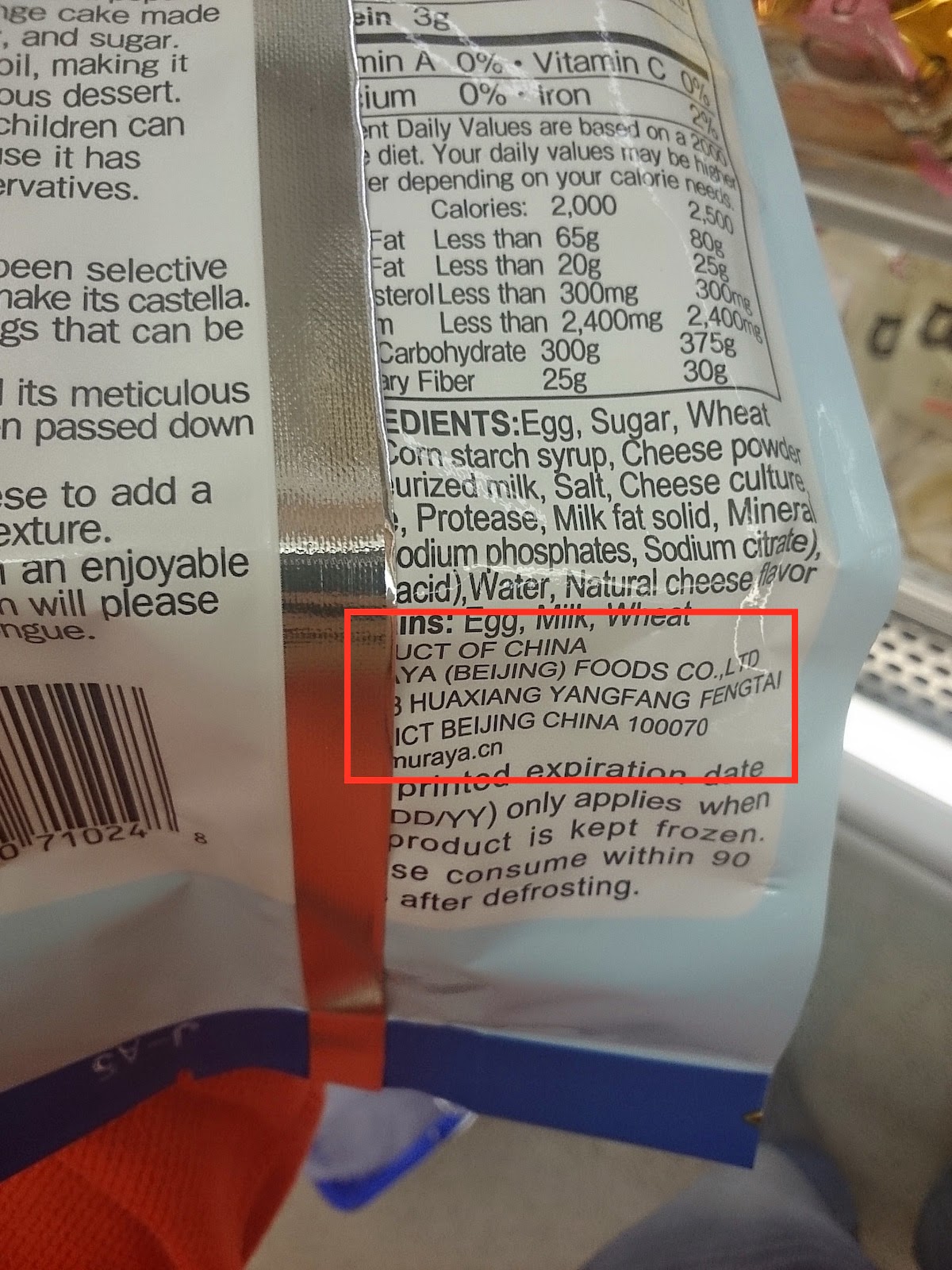
Whoa! What the what?! Imuraya, a real Japanese company if you were concerned, actually made this deceptively Japanese item at their Chinese subsidiary, Imuraya (Beijing) Foods Co., Ltd. So this 500-year-old tale of globalization has now seen this Portuguese export going to Japan, then to China, and end up here in a Asian supermarket in California. Not bad!
There's only one problem and it really bothers me. All that Japanese writing... who is that for, exactly? I can tell you point blank that this packaging is not eligible for sale in Japan. The nutrition info, English, and UPC code more than give it away. This was a product that was always meant to be exported to the US. And despite what you might think, I can tell you that Japanese speakers in the US are a very rare group. So the only thing that I can think of is that all that Japanese writing that virtually nobody is going to bother reading is actually meant to lead (and I dare say mislead) unsuspecting consumers into thinking that this is actually a Japanese import. The ones most at risk? East Asian immigrants who can easily tell that the written script is Japanese, but can't read that much English. Even this perfectly legal and properly-labeled package won't help them out here. And for those of you who are reading this and whose English is fine, ask yourselves: would you have noticed this whopper of a marketing gimmick? Take a CLOSE look the next time you visit your Asian grocer. Make sure you know what you're buying.
See Part 2 for my investigation into fake mochi...
P.S. Just to be clear, I did not purchase the Castella cake, but as far as I can tell there is nothing wrong with the quality or safety of this product.
 |
| At first glance, a rather innocuous-looking product from Japan, complete with Engrish typo. |
People associate Japan with many things, and one of those in this day and age is quality. When it comes to issues of food safety, matters that may seem quite trivial or commonplace to you and me could easily result in a scandal in Japan. (In 2014, McDonald's Japan was the latest high-profile company to get hit after it was discovered that a Shanghai-based chicken supplier got into the Japanese supply chain. Profits were decimated for the year.)
So what about about this cheese-flavored "Castilla" is weird? (Having spent time in Asia, you develop a a healthy immunity to bad translations and misspellings.) It's a Japanese import, so having writing in Japanese is totally expected, right? Let's take a look at the back:
More Japanese writing. It's an explanation of what a Castella (<-- the proper spelling) is, and if you're wondering, it's pretty much in-line with the English portion. And in typical Japanese fashion, they completely neglect to say that this "traditional Japanese" dessert (日本の伝統デザート) is actually by way of Portuguese traders half a millennium ago. But I digress. Let's take one last look:
Whoa! What the what?! Imuraya, a real Japanese company if you were concerned, actually made this deceptively Japanese item at their Chinese subsidiary, Imuraya (Beijing) Foods Co., Ltd. So this 500-year-old tale of globalization has now seen this Portuguese export going to Japan, then to China, and end up here in a Asian supermarket in California. Not bad!
There's only one problem and it really bothers me. All that Japanese writing... who is that for, exactly? I can tell you point blank that this packaging is not eligible for sale in Japan. The nutrition info, English, and UPC code more than give it away. This was a product that was always meant to be exported to the US. And despite what you might think, I can tell you that Japanese speakers in the US are a very rare group. So the only thing that I can think of is that all that Japanese writing that virtually nobody is going to bother reading is actually meant to lead (and I dare say mislead) unsuspecting consumers into thinking that this is actually a Japanese import. The ones most at risk? East Asian immigrants who can easily tell that the written script is Japanese, but can't read that much English. Even this perfectly legal and properly-labeled package won't help them out here. And for those of you who are reading this and whose English is fine, ask yourselves: would you have noticed this whopper of a marketing gimmick? Take a CLOSE look the next time you visit your Asian grocer. Make sure you know what you're buying.
See Part 2 for my investigation into fake mochi...
P.S. Just to be clear, I did not purchase the Castella cake, but as far as I can tell there is nothing wrong with the quality or safety of this product.
Subscribe to:
Posts (Atom)